What this redesign delivered
The situation
Parents visiting Officeworks' BYOD (Bring Your Own Device) page were struggling to find the entry point to make confident device decisions for their children. The experience was designed around browsing rather than decision-making, leaving parents without the guidance they needed to navigate school device requirements, budget, and grade-appropriate choices.
Behavioural data pointed to a fragmented, high-friction experience. Parents were bouncing early, entering from multiple disconnected entry points, and heavily relying on a single "Find my school" button under the screen fold as their only anchor, signalling they did not know where else to start.
Reframing the problem
The real issue was not a page needing full redesign, but the buried main entry point and the absence of a decision-led experience for parents navigating a high-stakes purchase with multiple unknowns.
What I was responsible for
My task was to understand how parents make device decisions, identify where the experience was breaking down, and redesign the BYOD journey to match how parents actually think, not how the system was organised.
I also needed to align stakeholders around a significant shift in direction: from an exploratory browsing model to a guided, intent-based experience. That required building a clear, evidence-based case before any design work could land.
How I solved it
I started by analysing behavioural patterns to understand where and why parents were dropping off. High bounce rates, fragmented entry points, and over-reliance on the "Find my school" button indicated parents lacked a clear starting point that matched their actual situation.
I then conducted user interviews to understand how parents approach device decisions, what information they had coming in, and what made the process feel overwhelming. The findings were compiled into a research pack shared with stakeholders to build shared understanding of the user reality.

Interviews surfaced two distinct personas with fundamentally different needs, which shaped the entire design direction. A key finding was that first-time and returning buyers approached the page with opposite mental models: first-timers arrived uncertain and anxious, needing guidance before they could act, while returning buyers arrived with intent, frustrated by anything that slowed them down.


Sarah, 34
Mum of a Year 7 student, first BYOD purchase, suburban Melbourne
New to BYOD, high anxiety, needs to be guided
- —Education about requirements
- —Recommendations she can trust
- —Reassurance before committing

David, 48
Dad of two teenagers, replacing a broken device, time-poor professional
Knows what he wants, low patience, needs speed
- —Fast replacement
- —Quick upgrades
- —Better value than last time
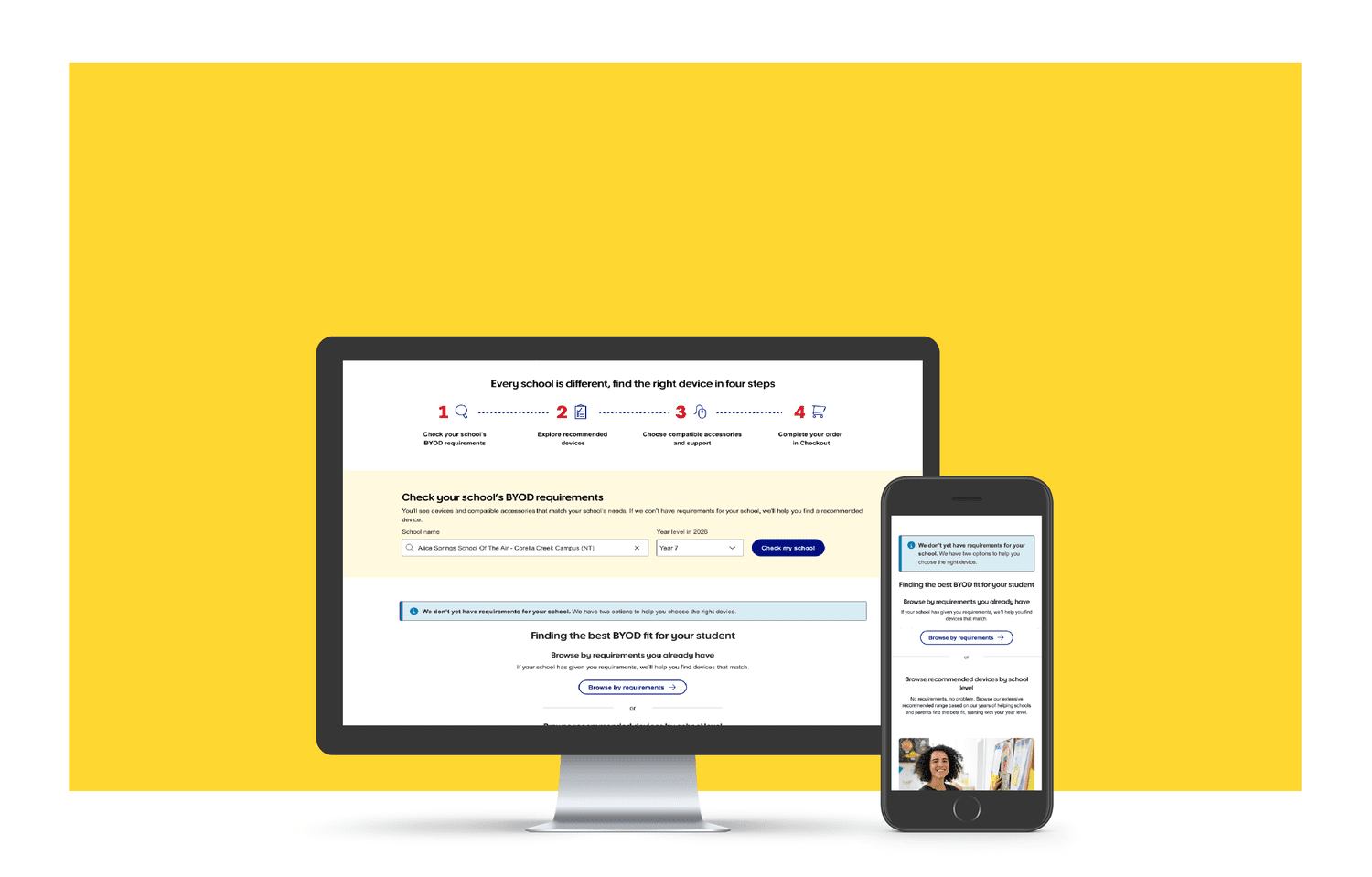
One page had to serve both without confusion. This shaped the decision to create a simple guided finder: if school requirements were found, route to a direct recommendation; if not, guide the parent to browse by school year or device type.
Three recommendations from the research
- —Create a guided finder based on 2 pathways: school requirements found routes to a direct recommendation; no requirements found routes to browsing by school year or device type.
- —Change the hero headline from "Shop BYOD Devices" to "Find the right device for your student", shifting the framing from transactional to supportive.
- —Add a trust signal above the fold: "You'll see devices and compatible accessories that match your school's needs. If we don't have requirements for your school, we will help you find recommended devices." This addressed the anxiety first-time buyers felt before they had even started.
What I designed
I started with low-fidelity designs, which validated my research findings before moving into high-fidelity. A guided, intent-based BYOD experience structured around 2 clear entry pathways, each mapped to a different parent situation:

"Check my school"
For parents whose school requirements were already captured in the system, giving them a direct, confident path to the right device.
"Browse by school year or device type"
For parents with no requirements yet, supported by system recommendations based on popular choices for their child's school year and device category.
Across both pathways, I embedded reassurance signals around school fit, price confidence, and fulfilment options to reduce anxiety and support decision-making at key moments.
I validated the direction early using low-fidelity prototypes and moderated usability testing with 6 participants, testing multiple concepts to directly compare guided versus non-guided approaches. 83% of users preferred guided pathways, and 100% benefited from structured layouts.

Detailed outcomes
The team implemented a structured BYOD landing experience aligned to the guided approach. The redesign introduced clearer entry pathways, improved content hierarchy, and reduced dead-end states by embedding actionable next steps throughout the journey.
- Approximately 30% reduction in bounce rate by eliminating dead ends and giving parents a clear starting point
- 50% increase in "Check my school" engagement via button clicks, indicating parents found the right pathway faster
- Stakeholder alignment achieved around a decision-led model, shifting the team's perspective from page improvement to experience design
- 100% of usability test participants benefited from structured layouts, regardless of pathway preference
What I would carry forward
Key learning
The most impactful reframe in this project was not visual, it was strategic. Shifting from "how do we improve this page" to "how do we design for a decision journey" changed everything: the research questions, the design approach, the stakeholder conversations, and ultimately the outcome.
- Behaviour data is a compass, not a map: the clickstream told me where parents were getting stuck, but user interviews told me why, and the "why" was what unlocked the right solution
- Presenting research findings as a shared pack before showing any designs is one of the most effective ways to shift stakeholder thinking. The solution becomes obvious once everyone sees the same reality
- Designing for 2 distinct mental models within a single page is harder than designing two separate pages, but it is worth it: the right entry point removes anxiety before it starts